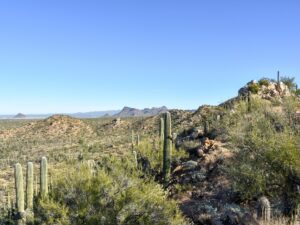
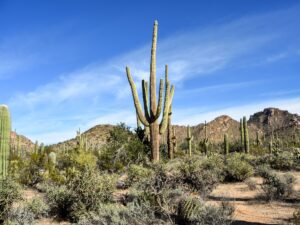
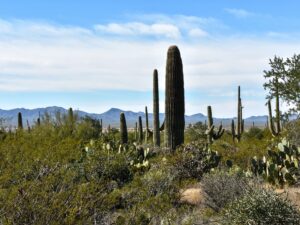
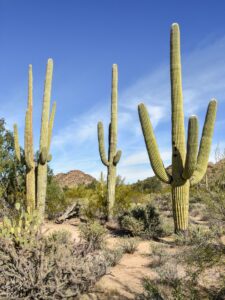
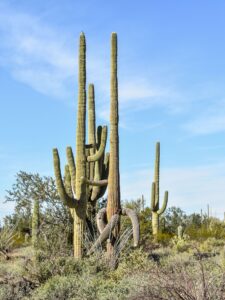
While staying in Tucson, we were excited to explore Saguaro National Park (pronounced “sah-wah-roh”). The city splits the two park districts – the Tucson Mountain District (TMD) to the west and the Rincon Mountain District (RMD) to the east. Since we had two days at the park, I wanted to make sure we explored both districts and did both scenic drives. Below are 5 hikes you should consider in Saguaro National Park.
Saguaro National Park 2023 Price: Free due to my Annual Pass (Fee would have been $25 for a 7-day pass)
Sendero-Esperanza Trail
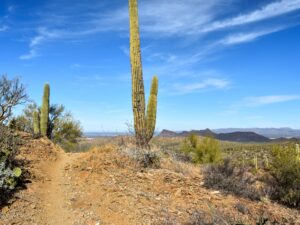
We started in the Tucson Mountain District with the Sendero-Esperanza Trail. It is 3.4 miles round trip and climbs up to the ridgeline. I would rate it as moderate difficulty.
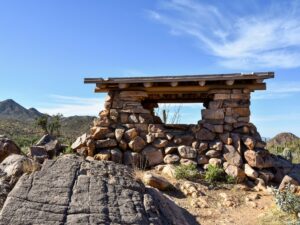
There is a bumpy, dirt road to reach the trailhead but it is worth it. We stopped for a quick look at the Ez-Kim-In-Zin picnic area first. There are some beautiful landscapes here and I loved the stone picnic shelter.
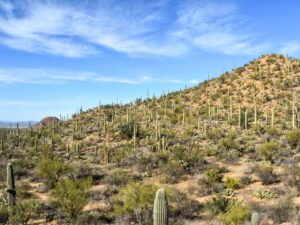
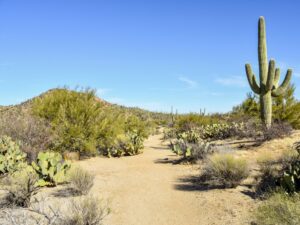
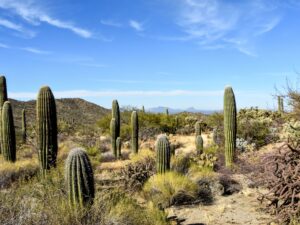
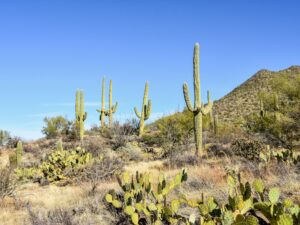
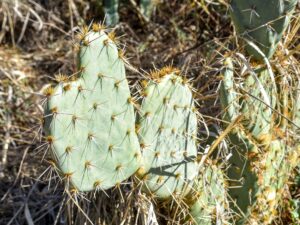
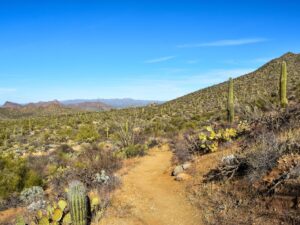
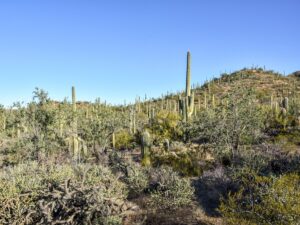
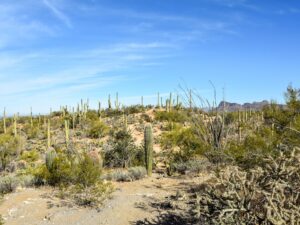
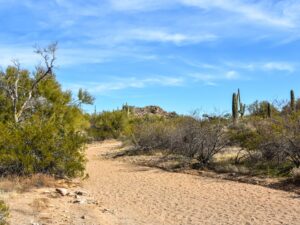
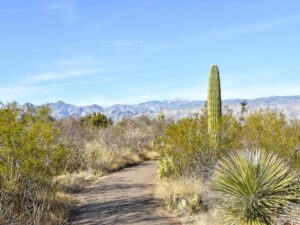
The Sendero-Esperanza Trail starts with a flat, wide dirt path. Saguaro, cholla and prickly pear cacti cover the landscape.
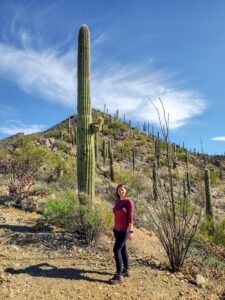
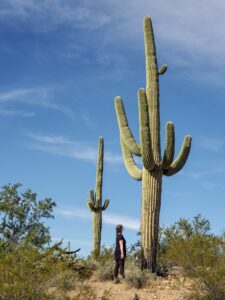
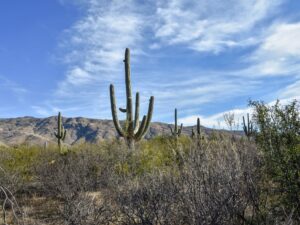
Saguaro cacti only grow in the Sonoran Desert. They live up to 200 years and typically do not get their first arm (branch) until they are 50 to 70 years old.
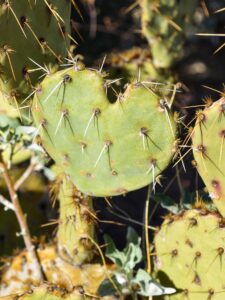
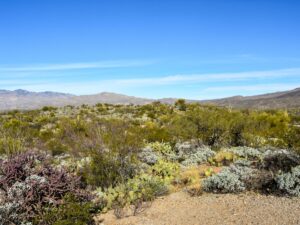
We were surprised how much color we saw even in January. I am always on the lookout for heart-shaped pads. We found a couple of good ones.
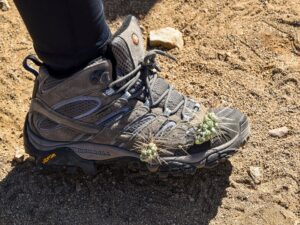
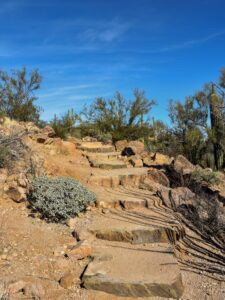
The trail then grows narrower and steeper up the mountain on switchbacks. Take care where you step – the loose rocks can slide, and I picked up some prickly friends from stepping too close to a cactus.
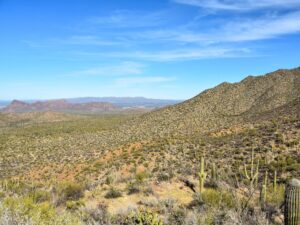
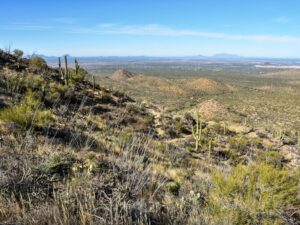
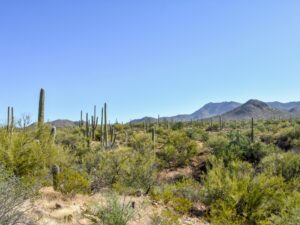
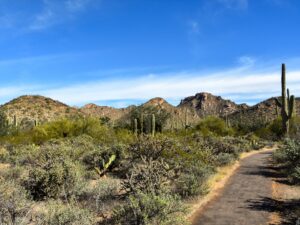
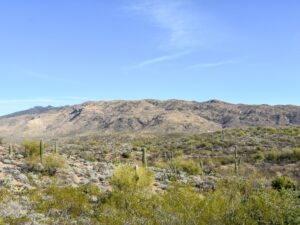
As you climb, there are gorgeous views of the valley and surrounding mountains.
Reaching the top of the ridgeline felt like such an accomplishment! For those looking for a longer hike, you can jump on the Hugh Norris Trail at the ridgeline and continue to Wasson Peak.
We spied lovely new birds like the curve-billed thrasher, black-throated sparrow, Gila woodpecker, verdin, and (my favorite) phainopepla.
This trail has a medium-sized parking area and restrooms.
Valley View Trail
Next, we tackled the Bajada Loop Drive in the TMD. This six-mile scenic drive is on a dirt road, but our small SUV was able to make it with little issue. Part of Hohokam Road is one-way, so I suggest you follow our route, starting on Hohokam Road near the visitor center and then turning left on Golden Gate Road.
Our first stop was the Valley View Trail. This is an easier 0.8-mile round trip trail with information signs; however, there are several sets of steps up to the top.
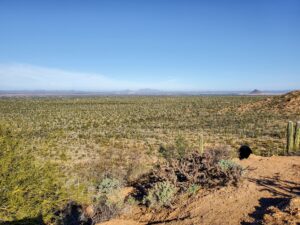
From the top, as the name implies, you get 360-degree views of the valley below. In the distance you can see Signal Hill Picnic Area, Picacho Peak State Park, Silverbell Mine, and Twin Peaks Mine.
A stone “View Trail” sign designates the small parking lot, big enough for 7 or 8 cars.
Signal Hill
Next on the Bajada Loop, we stopped at Signal Hill Picnic Area.
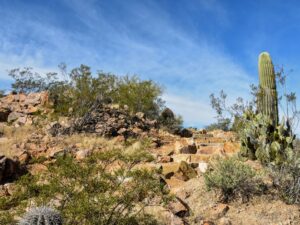
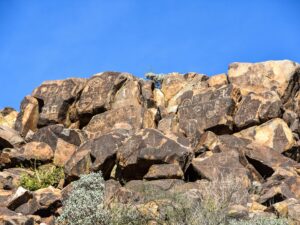
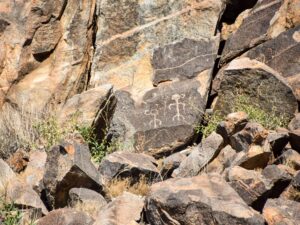
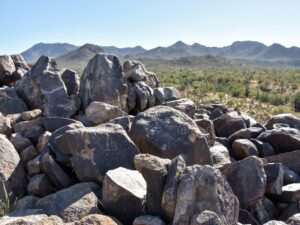
The Signal Hill Trail is a half-mile round trip trail up the hill to see petroglyphs up close. There are a lot of steps on this trail, so it is not ideal for those with mobility issues or strollers.
Stick figures, game animals, lizards, snakes, and geometric shapes are common. According to the National Park Service, abstract designs outnumber lifeforms at most sites in Tucson.
You can see some of the petroglyphs before scaling the steps. I really loved the spirals and figures of men.
Here is the view from the top of Signal Hill.
People have occupied the Tucson Basin for more than 10,000 years. The petroglyphs were created by the Hohokam people who stayed on the land from 200 to 1450 CE. Hohokam means “the people who have gone.” They were desert farmers.
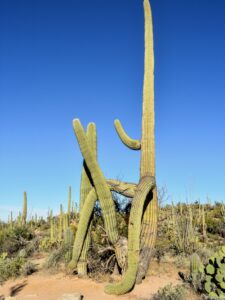
After scaling the hill, we walked a bit on the wash trail to the Manville Trail. This tall cactus caught my eye!
The picnic area has a large parking lot, restrooms, picnic areas, grills, and shelters.
Desert Discovery Nature Trail
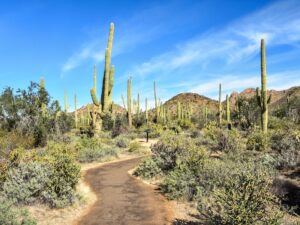
Our last stop on the Bajada Loop was the Desert Discovery Trail. This is a 0.5-mile universally accessible paved loop.
There are information signs about native flora and fauna along the trail.
We found verdin hopping about, black-throated sparrows, and grasshoppers.
This has a small parking lot, with only 4 or 5 parking spaces. The stone “Nature Trail” sign for the trail is across the road.
Desert Ecology Trail
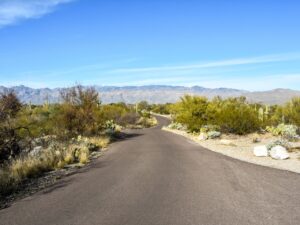
Finally, we left the TMD and drove to the Rincon Mountain District. Here we drove the 8-mile Cactus Forest Drive. This scenic drive is a paved one-way road through Saguaro National Park East.
Several overlooks dot Cactus Forest Drive which highlights the landscape and area’s history.
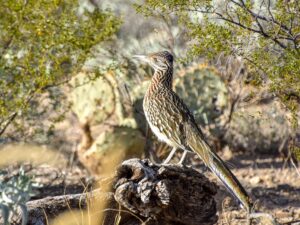
It was at one of these stops that I finally got a photograph of a greater roadrunner! We had already seen one dart across the road in front of us in the TMD, but we spied this one run ahead of us and were able to pull off at an overlook. It kindly posed for a few photos and then ran off into the brush.
Just before the drive’s halfway point, there is a small parking lot for the Desert Ecology Trail. It is a 0.25-mile universally accessible paved loop through the desert beside the Javelina Wash.
For those looking for longer hikes, there is the Cactus Forest Trail within the loop and several backcountry trails.
That night we ate at Cheddar’s Scratch Kitchen. I had a fantastic Dijon chicken, and mom liked her grilled salmon.