Tucked away in northeastern Alabama, Cathedral Caverns State Park offers an experience that feels less like a simple cave tour and more like an expedition into a hidden world. Inside, visitors wander through a series of grand chambers where nature’s architecture is on display in a living gallery of stone. The beauty and geological significance of these features earned the caverns a designation as a National Natural Landmark.
This area was developed as a tourist attraction by photographer Jacob “Jay” Gurley in the 1950s. Originally named “Bat Cave,” Gurley changed the name at the request of his wife due to the cathedral-like appearance of some chambers.
Cathedral Caverns State Park 2026 Price: $20 per adult
Formations
Cathedral Caverns is a living cave where formations are still growing, though at a rate of about one inch every 100 years. Below are key speleothem terms you should know.
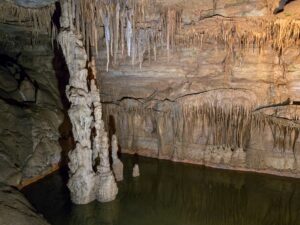
Stalactites form as mineral-rich water drips from cracks, leaving behind tiny calcite rings that eventually stack into stony icicles. Easy ways to remember:
These formations hang “tight” to the ceiling.
Stalactite is spelled with a “c” for ceiling.
Stalagmites rise from the floor, formed by water dripping from above. Because the water splashes upon impact, stalagmites usually have a thicker, rounded, or mound-like appearance. Easy ways to remember:
They “might” reach the ceiling one day.
Stalagmite is spelled with a “g” for ground.
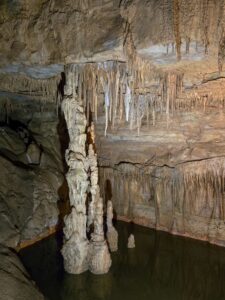
When a stalactite and stalagmite eventually meet after thousands of years, they fuse into a solid pillar called a column.
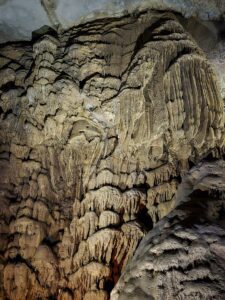
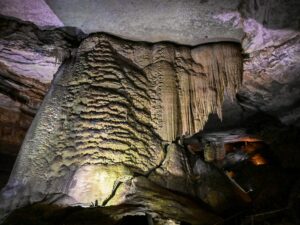
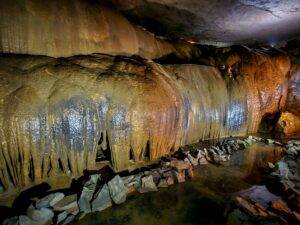
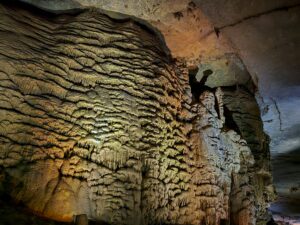
Rather than dripping, water sometimes films over walls or floors. This creates smooth, sheet-like deposits called flowstone. They often resemble frozen waterfalls or draped fabric.
Cave Tour
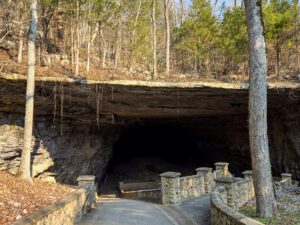
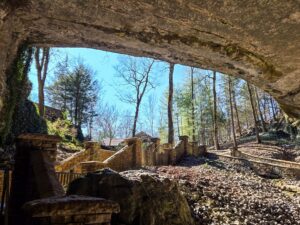
The entrance to Cathedral Caverns is a staggering 126 feet wide and 25 feet high, earning the nickname “Giant’s Mouth.” Despite the nearly flat, horizontal line across the top, the opening is entirely naturally occurring.
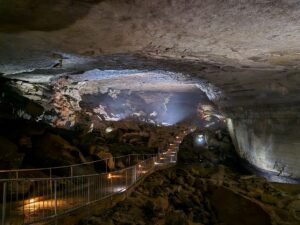
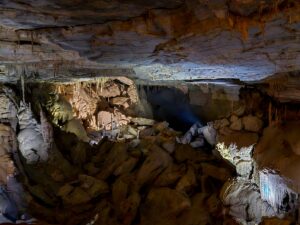
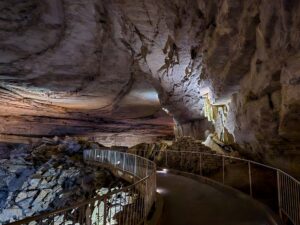
We followed our guide, Stephanie, along the wide path. Photos don’t do justice to the sheer size of the chambers.
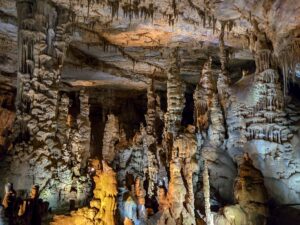
One of the first sights to command attention was Goliath, an immense stalagmite column standing 40 feet high and measuring 240 feet around.
Mystery River appeared along the path, disappearing at times and creating reflecting pools. This underground river eventually leaves the main cave to surface at Bryant Spring in the neighboring valley.
Further along, the Frozen Waterfall came into view – a stunning layer of flowstone that mimics water cascading mid-air, forever preserved in stone.
Then we walked along a 30-foot-high Flowstone Wall. Stephanie pointed out figures in the rock. My favorite, and the easiest for me to see, was a caveman holding a club perched atop the wall.
The highest concentration of formations is found within the Stalagmite Forest, where the path winds for 1,200 feet across three levels. When she saw it, Mrs. Gurley told her husband to rename the attraction because according to her a room with towering columns (Pearly Gates) and stalagmites resembled an underground cathedral.
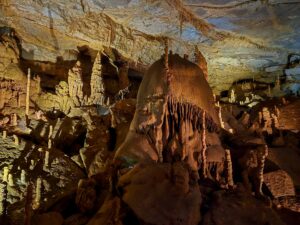
The formations invite a lot of imagination; in one stalagmite two distinct figures appeared to me – a jellyfish and a Darth Vader helmet. Do you see it?
The journey culminated at The Pinnacle, located 3,559 feet into the cave. A unique 27-foot stalagmite is pitched at a sharp 45-degree angle, standing as a gravity-defying landmark at the tour’s end.
Before turning back, Stephanie turned off all the lights, allowing us to experience total darkness.
While the tour concludes here, the caverns continue for another 2,000 feet through the mountain. To date, over two miles of passageways have been discovered, though they remain the domain of experienced speleologists.
From the darkness of the Pinnacle, the return trek offered one last look at the formations while retracing the path back to the daylight of the Giant’s Mouth.
Know Before You Go
Length: 1.5 miles round trip, approximately 90 minutes
Accessibility: Cathedral Caverns is one of the most accessible tours in the region with a smooth, wide path. Other than the initial cave entrance, which is a steeper incline on the way out, the path is relatively flat. Visitors enjoy an open walkway that requires no crouching, crawling, or navigating through tight spaces.
Temperature: The cave is consistently around 60°F year-round
Footwear: Wear shoes with good tread as the cave floor can be damp and slick
School groups: Spring and autumn are popular for school field trips, which are usually scheduled in the morning. The park recommends planning visits for noon or later during these months.
Additional Activities
Approximately 5.5 miles of hiking trails span the park. Trails are indicated by color with painted blazes. We hiked the 0.25-mile red interpretive trail behind the welcome center. It circles a sink hole with information signs explaining local geology. We found a couple of chipmunks and songbirds, including American robins, cedar waxwings, eastern bluebirds, hermit thrushes, and tufted titmice.
Gemstone mining is popular with younger visitors. After selecting mining dirt packages with rough-cut gems, fossils, or seashells, visitors pan the dirt in custom-made flumes. “Miners” can compare their finds with the accompanying identification guide.
Cathedral Caverns State Park is a standout destination, not just for the cave’s scale, but for how accessible it is. Whether it’s for geological history or awe of a deep cavern, this park offers a powerful encounter with a world hidden just beneath the surface.

A great way to remember the two stalactites and stalagmites. Great description of your tour. I like the Darth Vader helmet.