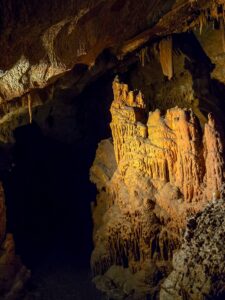
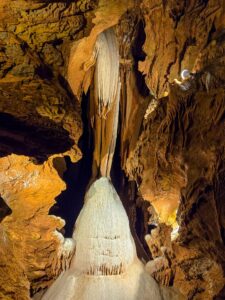
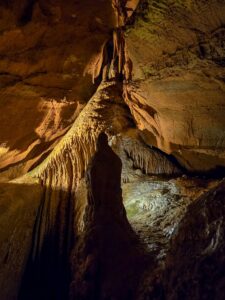
In the valley near Shenandoah National Park, Shenandoah Caverns offers an escape into a wonderland where towering flowstone and massive draperies create a breathtaking gallery of living geology. This historic cave proves that some of Virginia’s most spectacular views don’t have a skyline at all.
Discovered in 1884 during the construction of the Southern Railway, Shenandoah Caverns was first explored by two sons of local farmer Abraham Neff. After spotting cold air rushing from a hole in the ground, the boys grabbed ropes and candles to investigate the dark shaft below. In 1922, businessman Hunter Chapman bought the property to transform the hidden cave into a public attraction. The caverns found their long-term caretakers in 1966 when Earl Hargrove purchased the property, and his family continues to welcome travelers to this day.
Formations
There are more than 4,000 caves in Virginia. Below are key speleothem terms you should know.
A cave refers to the overall structure, and caverns are the individual rooms within the cave.
Stalactites form as mineral-rich water drips from cracks, leaving behind tiny calcite rings that eventually stack into stony icicles. Easy ways to remember:
These formations hang “tight” to the ceiling.
Stalactite is spelled with a “c” for ceiling.
Stalagmites rise from the floor, formed by water dripping from above. Because the water splashes upon impact, stalagmites usually have a thicker, rounded, or mound-like appearance. Easy ways to remember:
They “might” reach the ceiling one day.
Stalagmite is spelled with a “g” for ground.
When a stalactite and stalagmite eventually meet after thousands of years, they fuse into a solid pillar called a column.
Rather than dripping, water sometimes films over walls or floors. This creates smooth, sheet-like deposits called flowstone. They often resemble frozen waterfalls or draped fabric.
Also known as cave bacon, draperies form when water trickles down a slanted ceiling. They leave behind thin, wavy, and often translucent mineral trails that can look like colorful strips of fabric.
Cave popcorn, or coralloids, are small nodes ranging from tiny beads to large clusters.
Cave Tour
Though the entire cave system has been explored, the tour loops through 17 unique caverns, covering about 80% of the cave. Our guide, Vanessa, gave us an overview before sending us down the 79 steps into the heart of the caverns.
Note: For those with mobility issues, Shenandoah Caverns is Virginia’s only cavern with an elevator!
Shenandoah Caverns 2026 Price: $34 per adult
Long View Hall is the massive, long entryway to the subterranean trail. We had our first sense of scale, staring in awe at its high ceilings and jagged walls.
Shenandoah Caverns’ bacon formations in Bacon Hall were featured in a 1964 issue of National Geographic Magazine. They are very realistic with alternating dark brown, orange, and cream-colored bands.
Here there were two railings:
A wishing well where visitors can toss coins which are gathered every few years and donated to charity.
A view below into the cavern’s third floor.
Next, we explored the Grotto of the Gods, the very cavern where the Neff brothers first completed their daring descent, before entering Drapery Hall. Sitting 220 feet below the surface, this stunning room serves as the deepest point of the tour.
We spent a long time in Cathedral Hall as there are several interesting formations here. An elephant, crocodile, and bear form a stone zoo. The cave bear was my favorite!
Cathedral Hall offers the first opportunity to spot one of the tour’s most iconic optical illusions, the Cave Bishop. This elusive, natural silhouette is tucked deep within the jagged rock formations, only clearly visible from a precise spot in the chamber.
Then we moved into the Diamond Cascade where the flowstone wall shimmers with calcite crystal. I loved the pure white section which reminded me of a waterfall over rocks.
Giants Room was named for the three huge boulders that fell in an earthquake 7,000 years ago.
First Level
Up to this point, the tour explored the second level of the cave. After Giants Room, we climbed a ramp up to the first level.
Cardross Castle is a fairytale rock formation resembling a medieval fortress on the edge of a cliff.
Rainbow Lake is a guaranteed crowd-pleaser. Colorful neon lights give the shallow lake its name and create a glowing oasis. The reflective, still surface makes the 45-foot pool look longer and deeper.
Rainbow Lake is the farthest point, and we started back toward the entrance; however, there is one new cavern on the return walk – Capitol Dome.
Capitol Dome is the largest stalagmite in the cave and is still actively growing. It mimics the famous dome in Washinton D.C.
Nearby, we finally got to see the Cave Bishop up close. It is only 3 feet tall!
As you wander along the trail, don’t be surprised if you suddenly feel a stray drop of water land on your head. Known as a “cave kiss,” these drips from the ceiling are considered a sign of good luck. I received two cave kisses on my tour.
Know Before You Go
Length: 1 mile on gravel pathways, approximately 1 hour
Accessibility: Shenandoah Caverns is one of the most accessible tours in the region with an elevator into the caverns. Wheelchairs and mobility devices can access close to 80% of the caverns but may need assistance. The pathway is crushed gravel, with inclines and declines.
Temperature: The cave is consistently around 56°F year-round
Footwear: Wear shoes with good tread as the cave floor can be wet
Additional Activities
After our tour we had lunch at the 1950s-inspired Caverns Café. We enjoyed our burgers and I opted for an old-fashioned root beer.
Visitors can purchase a combination ticket that also includes the American Celebration on Parade. In addition to owning the caverns, the Hargroves have created larger than life parade floats for inaugural parades, starting with Harry Truman, and continuing for every Presidential inaugural parade since. Mr. Hargrove created a permanent attraction from his refurbished collections, including props and 15 parade floats.
The seasonal gemstone sluice gives visitors of all ages a chance to step into a miner’s boots. After purchasing a bag of mining rough, you can pan through the running waters to sift out real gemstones and arrowheads to take home.
Wandering among illuminated stone draperies, soaring caverns, and crystal-clear lakes offers a front-row seat to millions of years of geological history. The quiet majesty of Shenandoah Caverns will have you looking at the Shenandoah Valley with a whole new sense of awe.



Once again, your writing of the locations you have traveled leave a person longing to visit. Thank you for taking me on this journey.