For those wanting a blend of history and outdoor recreation, Andrew Jackson State Park offers a unique landscape where the past meets the present. It marks the approximate birthplace of the seventh president of the United States. Visitors enjoy a dedicated museum, bronze statue, 18-acre lake, and hiking trails.
Andrew Jackson State Park 2026 Price: Free due to my All Park Passport (Fee would have been $3 per person)
Garden of the Waxhaws Trail
The Waxhaw people inhabited the region long before the arrival of European settlers. Though the tribe had largely disappeared before the future president’s birth, their name endured as a geographic designation for a stretch of the Carolinas’ Piedmont region.
The surrounding forests were promoted as the Garden of the Waxhaws during Jackson’s childhood. In 1859, John Logan wrote “The forests of those early times were far more imposing than any now remaining … The trees were generally larger and stood so wide apart that a deer or a buffalo could be easily seen at a long distance.”
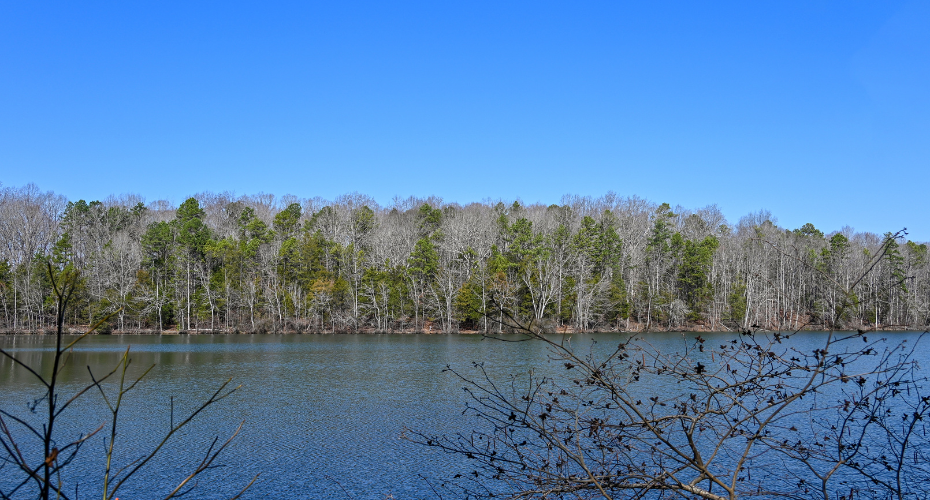
I started my day with the 1-mile Garden of the Waxhaws loop. Circling the park lake, this moderate hike winds through towering pines and hardwoods that frame the shoreline. Obstacles include large tree roots, stairs, a slight elevation gain, and muddy areas after rainfall.
There are ample opportunities for birding. The trees were alive with American crows, Carolina wrens, and tufted titmice. Along the water’s edge, sightings included a diving belted kingfisher and over a dozen Canada geese gliding across the surface.
Painted turtles and sliders crowded onto fallen logs, stretching out to bask in the warmth of the morning light.
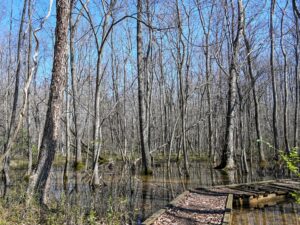
Near the boardwalk section, clear evidence of beaver activity was unmistakable – freshly gnawed trunks and nearby dams. Sadly, I did not see the elusive creatures themselves.
Crawford Trail / Nature Trail
Crawford Trail strikes out deeper into the mixed oak, cedar, and pine forest, away from the more high-traffic areas. Quiet and solitude reward visitors with native ferns, wildflowers, and woodland creatures.
Here the air was filled with the sweet songs of Carolina chickadees, palm warblers, and yellow-rumped warblers.
While the park officially classifies the route as an easy trail, I find it leans more toward an easy-to-moderate level difficulty. The terrain demands careful footing due to a network of exposed roots and a set of stairs. The far end of the loop had a slight but extended incline where the dirt trail appeared significantly washed out, creating a narrow gully with slanted sides that required a bit more agility.
Starting to the right of the Meeting House, the 1.1-mile loop crosses Old Church Road twice. On the return crossing, the trail reconnects approximately 150 feet to the left.
History Loop
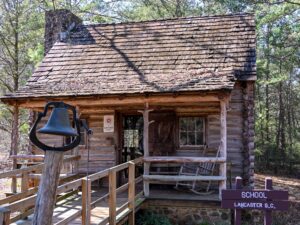
Finally, I explored the grounds near the museum. A short loop of stone pavers offers an easy walk by memorials, the museum, a reconstructed schoolhouse, and the Boy of the Waxhaws statue. It is an excellent starting point for those looking to understand the area’s heritage before heading into the woods.
Boy of the Waxhaws captures the youthful determination of Andrew Jackson. Anna Hyatt Huntington gifted the 10-foot, 3,500-pound bronze statue to the children of South Carolina. According to the historical marker, Anna depicted Jackson “as a young man of sixteen or seventeen seated bareback on a farm horse, one hand leaning back on the horse’s rump and looking over his native hills, to wonder what the future holds for him.”
An 18th-century replica schoolhouse is modeled after the building where the Jackson brothers received their early education. Nearby, the replica Presbyterian Meeting House offers a look at the community’s spiritual heart, recreating the environment where a young Andrew Jackson once attended services.
A visit to Andrew Jackson State Park is an invitation to reconnect with the rugged beauty of the South Carolina Piedmont and absorb a lesson in American history.
Beautifully described! I often see signs on I-77 just south of the North Carolina border but never visited. Your blog has made this place a destination.





Beautifully described! I often see signs on I-77 just south of the North Carolina border but never visited. Your blog has made this place a destination.