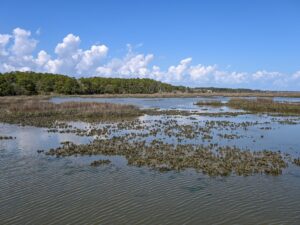
In early March, the South Carolina coast is still peaceful, and the spring migration has just begun. At Huntington Beach State Park, this transition feels like a slow, deliberate exhale. Here visitors can explore freshwater ponds, salt marshes, maritime forests, and sandy shores.
I planned my visit hoping to see well-known park wildlife: alligators, minks, turtles, and some of the 300 recorded bird species.
Huntington Beach State Park 2026 Price: Free due to my All Park Passport (Fee would have been $8 per adult)
The Causeway
While this road acts as the entrance to the park, there are accessible walking paths on both sides of the causeway. Flanked by the freshwater expanse of Mullet Pond on one side and the salt-saturated banks of Oaks Creek on the other, this area offers a unique ecosystem. At the end of the causeway, veer slightly right for a parking lot with access to these sidewalks.
I started along the oyster reefs, which emerge from the mud at low tide. I spent so much time watching a group of brown pelicans interact and hunt for food. They are relatively used to people, so I was able to get wonderful photos that normally I have to take from farther away.
Here my favorite wading birds explored the water – great blue, little blue, and tricolored herons; great and snowy egrets; and white ibises. The marsh was also alive with shorebirds like greater and lesser yellowlegs, least sandpipers, and willets digging in the mudflats.
Forster’s terns and tree swallows carved through the air, creating dramatic swoops. High above, the fan-favorite bald eagles soared with effortless grace.
On the pond side, I found several American alligators. Some were soaking up the sun on a grassy island while others swam along the banks.
Blue-winged and green-winged teals, northern shovelers, and pied-billed grebes swam near the observation decks. Anhingas and double-crested cormorants stood proudly on poles and the banks.
In the trees at the edge of the water, I could hear American robins, blue jays, Carolina wrens, northern cardinals, and tufted titmice singing. Common grackles, fish crows, and red-winged blackbirds used their black feathers to blend into shadows.
North Beach and Jetty
Next, I drove up to North Beach Access for a refreshing walk along the vibrant blue of the Atlantic Ocean. March was perfect timing for solitude before the summer crowds arrived.
On the water’s edge, I watched the common Atlantic shorebirds – American herring gulls, Bonaparte’s gulls, laughing gulls, and ring-billed gulls; common and Forster’s terns; and sanderlings. I was mesmerized by one sanderling as the tide came in because it created near perfect reflections.
Farther out from shore, pelicans grabbed their fish snacks as groups of double-crested cormorants surfed the waves.
The jetty sits at the northern end of the park, 1.2 miles from the North Beach Access point. Built with massive granite blocks, the barrier is paved on top to create a walkway for visitors to view the waters just offshore. It also creates a unique habitat for purple sandpipers and American mink.
I made the sandy trek out there hoping to find a mink but, as it was mid-afternoon, I assumed it was a long shot. I made it to the end of the jetty without spotting one and was halfway back when movement caught my eye. Then a brown blur popped out between two boulders before crossing the walkway yards ahead of me. He kept disappearing between blocks only to pop up again, as if playing a game of tag – and he was very competitive!
Then he bounded down to the beach, flopped onto his back, and rolled around in the sand like a dog! I was beaming watching him.
At low tide, a wreck is sometimes visible from the jetty—the ghost of a boat that sank after taking on water.
Atalaya Castle
For architecture lovers, there is a historic Moorish-style castle in the park. Philanthropist Archer Huntington and his wife, sculptor Anna Hyatt Huntington, built it in the early 1930s as a winter residence.
Archer designed the 30-room castle and employed local laborers to support the region during the Depression. Anna designed wrought iron grills to protect the windows during hurricanes. The 40-foot water tower at its center inspired the structure’s name – Atalaya means ‘watchtower’ in Spanish.
What made Huntington Beach State Park so captivating in this shoulder season was the ability to see a variety of ecosystems and species in one place. From the sun-warmed alligators stirring in the freshwater ponds to the shorebirds braving the Atlantic spray, the park functions as a massive, living sanctuary.