My ferry ride through the salt marshes of Cape Romain National Wildlife Refuge was a front-row seat to one of the most pristine coastal ecosystems on the Atlantic seaboard. Bulls Island can only be accessed by boat, so in early March I set out with Coastal Expeditions. Whether you are scanning the shoreline for birds or watching alligators bask in the sun, a journey to Bulls Island feels like stepping back into a wilder, untouched version of the Lowcountry.
Bulls Island Ferry with Coastal Expeditions 2026 Price: $55 per person
Stretching 22 miles across the South Carolina coast, Cape Romain National Wildlife Refuge spans from Cape Island in the north to its southernmost point at Bulls Island. Cape Romain’s Class I National Wilderness distinction recognizes this area as having some of the cleanest air on the East Coast.
Originally known as Oneiscau, a name bestowed by the Sewee people, Bulls Island served as a vital resource. Throughout the 17th and early 18th centuries, the Sewee inhabited the coastal expanse between Charleston and the Santee River, navigating the tidal creeks to fish and hunt game in the island’s maritime forests.
Ferry Ride
Matt and Jackie led our ferry ride. I wanted to spend as much time on the island as possible, so I signed up for the 9 a.m. time slot and was able to stay until the second return trip at 4 p.m. As I waited to board the boat, I watched laughing gulls and willets near the dock.
During the boat ride, Jackie explained the importance of the sprawling salt marsh estuary, a green ribbon dominated by Spartina grass. In early March, last season’s golden-brown stalks swayed with the green new growth. This cordgrass acts as the backbone of the refuge, filtering the tides, anchoring the mudflats, and providing a nursery for wildlife that calls these waters home.
As the boat entered the heart of the estuary, we had sightings of American oystercatchers perched on shoals and common loons gliding through the surrounding waters.
One of the most magical moments happened before we ever reached Bulls Island. We turned a corner and suddenly movement caught my eye. It was a mother dolphin and her calf! They were Tamanend’s bottlenose dolphins, a species of bottlenose dolphin that inhabits coastal waters. They were feeling playful and moved around the boat, popping in and out of the water. I was captivated – this was my first dolphin encounter in the wild.
Turkey Walk Trail
Next, we arrived at Bulls Island and Jackie offered her recommended hikes. I started with the 1.5-mile Turkey Walk Trail. It crosses the dike that separates the Summerhouse ponds and winds through the maritime forest of oak, palmetto, holly, and pine.
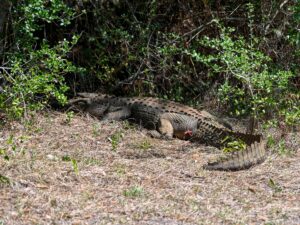
The biggest find along this stretch was the number of alligators. In Lower Summerhouse Pond, several smaller gators drifted quietly, while ahead, a massive specimen basked in the sun atop the dike. Just before the trail transitioned back into the shade of the woods, a final alligator hauled itself out of the marsh, settling onto a log to claim its spot in the morning warmth.
A single lesser scaup drifted across the open waters of Upper Summerhouse Pond. Overhead, tree swallows performed an aerial ballet, diving and soaring in graceful loops. Among the tree branches, I spotted Carolina chickadees, gray catbirds, northern cardinals, and yellow-rumped warblers flitting through the early spring foliage.
Emerging from the forest, I completed the loop along Beach Road. The marsh bushes were alive with crimson flashes from red-winged blackbirds, while a yellow rat snake slowly made its way across the path. Looking up, I caught the silhouettes of bald eagles soaring through the wide-open sky.
Boneyard Beach
The trek toward Boneyard Beach on the northeast corner of the island shows visitors how a maritime forest gradually yields to the spray of the Atlantic. Hundreds of palmettos, cedars, and pines are strewn along the 3-mile stretch of sand. These downed trees have been bleached by the sun and salt water, making them resemble a graveyard of bones.
When I first reached the beach, it looked like any other Atlantic coastline. There was soft sand and crashing tides. Then I turned to the left and, through a haze, saw the white skeletons in the distance.
As I drew closer to the water’s edge, the shoreline revealed a busy gathering of coastal birds. Groups of willets wandered along the surf, while a solitary piping plover meticulously searched the sand for its next meal. Above, the sky was equally active, with brown pelicans and Forster’s terns sweeping past on the ocean breeze.
Finally, I reached the edge of the Boneyard, where the incoming tide forced me to weave a path through the labyrinth of downed trunks. There was something captivating about the depth of the landscape, with the tree skeletons layering in the distance as far as I could see.
On one tree at the water’s edge, an osprey landed with its fish catch. I watched it tear into the sushi snack while waves crashed the trunk below.
It is easy to see why Boneyard Beach is the most photographed place on the island. It is a longer hike, around 2 miles one way, and taking the noon ferry back is not enough time to truly enjoy it.
End of Day
I had a relaxing lunch on the beach before turning back toward the dock.
My last surprise of the day was a large alligator in the tree line as I turned the corner. It gave a warning growl but otherwise did not move, so I gave it a wide berth and kept on going.
I had time before our pick up, so I settled in at the picnic area and gave my tired feet a rest. My table was under an old oak tree, providing some much-needed shade.
As the ferry pulled away from the dock for the return trip, the sun began its slow descent over the salt marsh, casting a golden glow on the waters of Cape Romain.
Your descriptions call out to anyone loving nature’s beauty. The way you took us through this beautiful Bulls Island tour is sure to draw visitors. Thanks once again
Steph, I fell a while back and have not been commenting lately. I continue to enjoy your blogs and experience
exciting travels through you. Keep up the good job. I will try another of your recommendations soon.


Your descriptions call out to anyone loving nature’s beauty. The way you took us through this beautiful Bulls Island tour is sure to draw visitors. Thanks once again
Steph, I fell a while back and have not been commenting lately. I continue to enjoy your blogs and experience
exciting travels through you. Keep up the good job. I will try another of your recommendations soon.